The electrical power plants park, including data on geolocations, installed capacities, etc.
for the different scenarios is set up in the dataset
PowerPlants.
Main inputs into the dataset are target capacities per technology and federal state in each scenario (see Modeling concept and scenarios) as well as the MaStR (see Marktstammdatenregister), OpenStreetMap (see OpenStreetMap) and potential areas (provided through the data bundle, see Data bundle) to distribute the generator capacities within each federal state region. The approach taken to distribute the target capacities within each federal state differs for the different technologies and is described in the following. The final distribution in the eGon2035 scenario is shown in figure Generator park in the eGon2035 scenario.
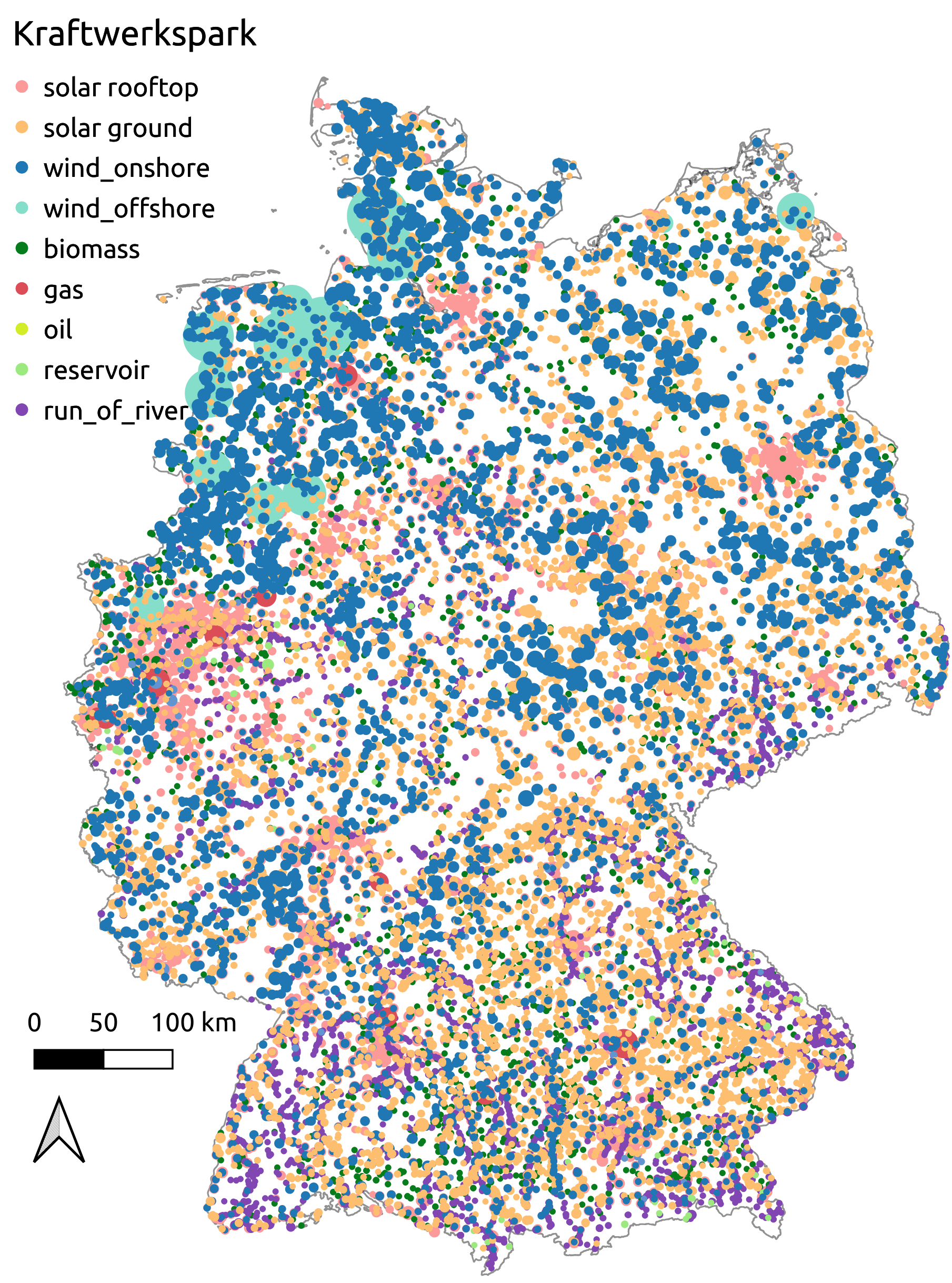
Generator park in the eGon2035 scenario
Onshore wind
Offshore wind
PV ground mounted
The distribution of PV ground mounted is implemented in function insert
which is part of the dataset PowerPlants.
The following steps are conducted:
- The sites and capacities of exisitng PV parks are imported using MaStR data (see Marktstammdatenregister).
- Potential areas for PV ground mounted are assumed to be areas next to highways and railways as well as on agricultural land with a low degree of utilisation, as it can be seen in figure Example: sites of existing PV ground mounted parks and potential areas. Those areas (provided through the data bundle, see Data bundle) are imported while merging or disgarding small areas.
- The locations of existing parks and the potential areas are intersected with each other while considering a buffer around the locations of existing parks to find out where there already are parks at or close to potential areas. This results in a selection of potential areas.
- The capacities of the existing parks are considered and compared to the target values for the specific scenario per federal state (see Modeling concept and scenarios). The required expansion capacity is derived.
- If expansion of PV ground mounted capacity is required, capacities are calculated depending on the area size of the formerly selected potential areas. The resulting parks are therefore located on the selected potential areas.
- The resulting capacities are compared to the target values for the specific scenario per federal state. If the target value is exceeded, a linear downscaling is conducted. If the target value is not reached yet, the remaining capacity is distributed linearly among the rest of the potential areas within the state.
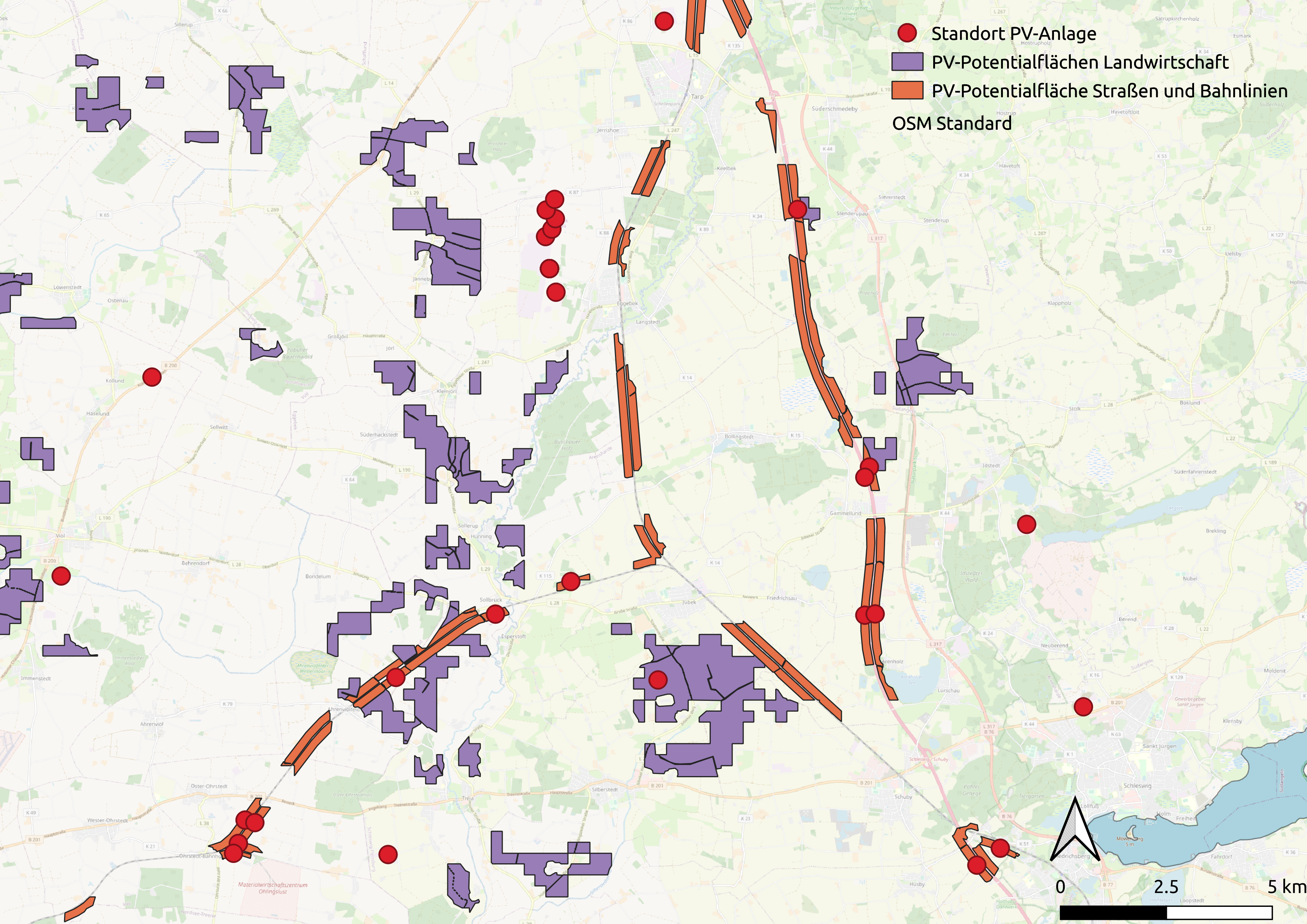
Example: sites of existing PV ground mounted parks and potential areas
PV rooftop
In a first step, the target capacity in the eGon2035 and eGon100RE scenarios is distributed
to all MV grid districts linear to the residential and CTS electricity demands in the
grid district (done in function
pv_rooftop_per_mv_grid).
Afterwards, the PV rooftop capacity per MV grid district is disaggregated
to individual buildings inside the grid district (done in function
pv_rooftop_to_buildings).
The basis for this is data from the MaStR, which is first cleaned and missing information
inferred, and then allocated to specific buildings. New PV plants are in a last step
added based on the capacity distribution from MaStR.
These steps are in more detail described in the following.
MaStR data cleaning and inference:
- Drop duplicates and entries with missing critical data.
- Determine most plausible capacity from multiple values given in MaStR data.
- Drop generators that don’t have a plausible capacity (23.5 MW > P > 0.1 kW).
- Randomly and weighted add a start-up date if it is missing.
- Extract zip and municipality from ‘site’ given in MaStR data.
- Geocode unique zip and municipality combinations with Nominatim (1 sec delay). Drop generators for which geocoding failed or which are located outside the municipalities of Germany.
- Add some visual sanity checks for cleaned data.
Allocation of MaStR plants to buildings:
- Allocate each generator to an existing building from OSM or a synthetic building (see Building data).
- Determine the quantile each generator and building is in depending on the capacity of the generator and the area of the polygon of the building.
- Randomly distribute generators within each municipality preferably within the same building area quantile as the generators are capacity wise.
- If not enough buildings exist within a municipality and quantile additional buildings from other quantiles are chosen randomly.
Disaggregation of PV rooftop scenario capacities:
- The scenario data per federal state is linearly distributed to the MV grid districts according to the PV rooftop potential per MV grid district.
- The rooftop potential is estimated from the building area given from the OSM buildings.
- Grid districts, which are located in several federal states, are allocated PV capacity according to their respective roof potential in the individual federal states.
- The disaggregation of PV plants within a grid district respects existing plants from MaStR, which did not reach their end of life.
- New PV plants are randomly and weighted generated using the capacity distribution of PV rooftop plants from MaStR.
- Plant metadata (e.g. plant orientation) is also added randomly and weighted using MaStR data as basis.
Hydro
In the case of hydropower plants, a distinction is made between the carrier run-of-river
and reservoir.
The methods to distribute and allocate are the same for both carriers.
In a first step all suitable power plants (correct carrier, valid geolocation, information
about federal state) are selected and their installed capacity is scaled to meet the target
values for the respective federal state and scenario.
Information about the voltage level the power plants are connected to is obtained. In case
no information is availabe the voltage level is identified using threshold values for the
installed capacity (see assign_voltage_level).
In a next step the correct grid connection point is identified based on the voltage level
and geolocation of the power plants (see assign_bus_id)
The resulting list of power plants it added to table
EgonPowerPlants.
Biomass
The allocation of biomass-based power plants follows the same method as the one for hydro
power plants and is performed in function insert_biomass_plants
Conventional
CHP
non-chp
In function allocate_conventional_non_chp_power_plants
capacities for conventional power plants, which are no chp plants, with carrier oil and
gas are allocated.